Luck, Opportunity, and a “true”Meritocracy 

March 8, 2016: 

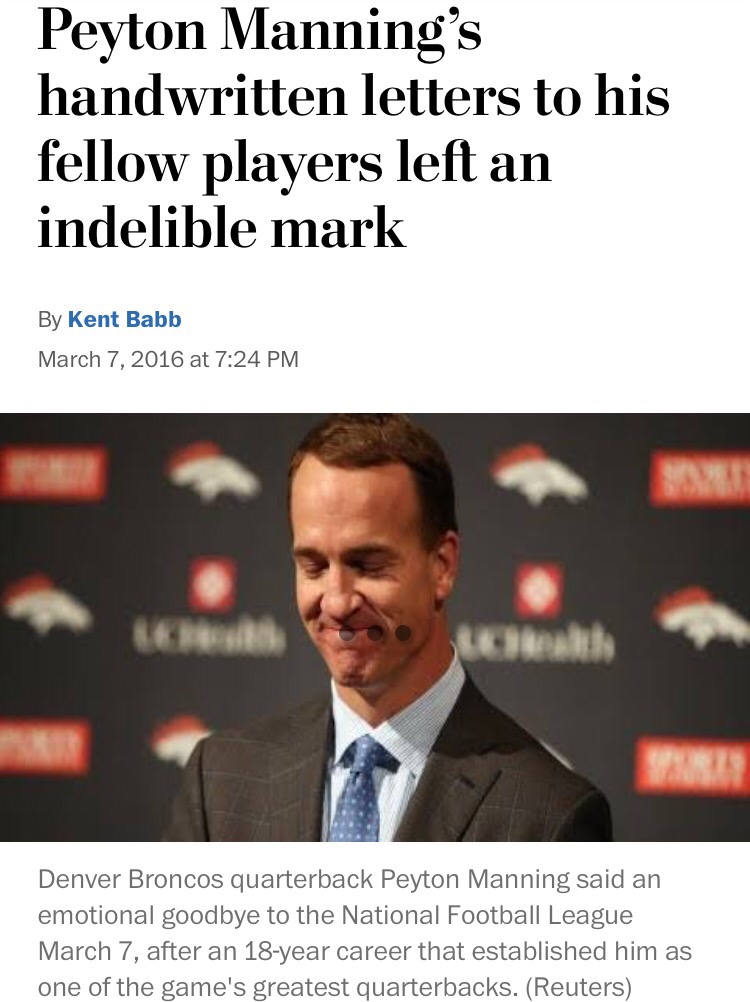
Peyton Manning’s career has so many things that are a microcosm of life – that so much of it is a lotto. Being born with talent is a lotto. But so is the NFL team you end up being drafted by – and that it can take almost two decades before you win a Superbowl, despite being amongst the best quarterbacks to have played in the NFL, ever.
That even talent, combined with preparation, and working harder than anybody else, doesn’t guarantee a result that lesser talented, less prepared, QBs might have accomplished before (Trent Dilfer, maybe?). 
This is true from the moment you are born – what country, what race, what gender, what economic class, in terms of the range of opportunities you’re likely exposed to. This is true where you work, the politics, the mentorship, whether the team you’ve been assigned to has the support of management, which can depend on your boss’s own relationship with the higher ups, whether, if you work for government, your organization’s mission is supported by Congress, and political sentiment at large (The SEC gets consistently underfunded due to Republican opposition, leading to a former boss, to tell the interns, as far as potential hiring, “you have to understand the waters you swim in”) . 

But it’s also worth reading Ben Bernanke’s Princeton 2013 speech, and Chad Pennington’s comments after being cut from the NY Jets years ago, when he then joined the Miami Dolphins. 

https://www.federalreserve.gov/newsevents/speech/bernanke20130602a.htm

3. The concept of success leads me to consider so-called meritocracies and their implications. We have been taught that meritocratic institutions and societies are fair. Putting aside the reality that no system, including our own, is really entirely meritocratic, meritocracies may be fairer and more efficient than some alternatives. But fair in an absolute sense? Think about it. A meritocracy is a system in which the people who are the luckiest in their health and genetic endowment; luckiest in terms of family support, encouragement, and, probably, income; luckiest in their educational and career opportunities; and luckiest in so many other ways difficult to enumerate–these are the folks who reap the largest rewards. The only way for even a putative meritocracy to hope to pass ethical muster, to be considered fair, is if those who are the luckiest in all of those respects also have the greatest responsibility to work hard, to contribute to the betterment of the world, and to share their luck with others. As the Gospel of Luke says (and I am sure my rabbi will forgive me for quoting the New Testament in a good cause): “From everyone to whom much has been given, much will be required; and from the one to whom much has been entrusted, even more will be demanded” (Luke 12:48, New Revised Standard Version Bible). Kind of grading on the curve, you might say.
4. Who is worthy of admiration? The admonition from Luke–which is shared by most ethical and philosophical traditions, by the way–helps with this question as well. Those most worthy of admiration are those who have made the best use of their advantages or, alternatively, coped most courageously with their adversities. I think most of us would agree that people who have, say, little formal schooling but labor honestly and diligently to help feed, clothe, and educate their families are deserving of greater respect–and help, if necessary–than many people who are superficially more successful. They’re more fun to have a beer with, too. That’s all that I know about sociology.

https://www.washingtonpost.com/sports/peyton-mannings-handwritten-letters-to-his-fellow-players-left-an-indelible-mark/2016/03/07/3760e12e-e4be-11e5-b0fd-073d5930a7b7_story.html?

Who is worthy of admiration?
Standard

Don’t do stupid shit

Strategic patience v tactical bias for action –

March 26, 2016

“What do you want you want us to do? Sit around and do nothing?!” – Battalion Operations Officer, Helmand Province, Afghanistan, 2010

Out S-3 or “Ops O” (Operations Officer) had lost his shit at me. I had just given our Battalion Commander a run down of the numbers I had come up with: Total of Afghans detained our first 90 days, total released, total handed over to either the local Afghan police or Afghan security service, total sent to Lashkar Gar, the provincial capital, for potential prosecution or onward to for longterm detention.

The NYPD and “stop and frisk”, viewed by its critics, on its worst day, might have appeared saintly.

Our detention standards/policy was far too relaxed (reminiscent of post-invasion Iraq’s rounding up of all “military-aged males” (MAMs in military acronym-jargon)).

Already, the Provincial Governor, in my daily meetings with him, was lamenting the number of complaints he was receiving from the villagers – That the Americans were being too heavy handed. Wives and mothers were showing up at the gates wondering how to support their families, and when would their men be released?

And now I had run the numbers.

Certainly, out of every 100 Afghan “MAMs” (a term I despised for the very implication that being both male and of a certain age was basis for detention) we detained, 4 might have been criminals, and 1 a no-shit Taliban insurgent. But, more importantly, what if – of the 95 who weren’t, the experience and indignity of detention caused them to harbor resentment against NATO forces, their provincial government (that could not stop the NATO forces from executing seemingly arbitrary detentions) – caused even a third of those 95 to become sympathetic to the Taliban? Or a third of that third to decide to actively support the Taliban against NATO forces/the Afghan government? If so, by detaining 100 Afghans to capture 1 Taliban was a net negative by potentially creating 10 more Taliban/insurgents.

The Ops O had a supporter in our S-2, intelligence officer. I had mine in our S-4, logistics officer. The breakdown was unsurprising: The intel officer’s job is to identify the “bad guys” and either neutralize and/or exploit them (for human intelligence). The logistics officer, on the other hand, was weary of the drain on his resources in supporting the effort required to move, house, feed, care for the Afghans we were detaining – and, by his observation (supported by my 90-day number crunch) – his Marines, vehicles, etc were not being efficiently deployed. The requirement to support a “liberal” detention policy was, in his view, unnecessarily competing for the more essential tasks of delivering supplies to various outposts, procuring supplies from higher headquarters, etc.

The line companies themselves just wanted clear guidance – they weren’t the “policy” makers – they just wanted Battalion leadership to give them clear guidance so they knew what to do.

I argued to our Battalion commander for a bigger picture, above the individual S-2, S-3, S-4 functions. What was our broader mission? What did we want to leave behind when we re-deployed to Southern California in another four months?

—–

Nick Talib: “We need to learn to think in second steps, chains of consequences, and side effects.”

*Naive intervention can be worse than doing nothing at all.

—–

#Antifragile is actually very relevant to approaches to counter-terrorism.

Arguments have already been made by seasoned “counterterror”and intelligence experts that loud responses and heavy-handed reactions to terror attacks only fuels more terrorism in the long-run: the loud responses merely confirm to the terrorists that they have achieved their goal, and their methods are effective (because their true goal was never to kill people – the method – but to create fear); the heavy-handed reactions potentially recruit more to the terrorists’ cause than “defeating” them.

But those arguments have only been drowned out by the 24-hour news cycle, and the notion that “strong leadership” means decisive actions (building walls, carpetbombing) or that deliberate restraint is is trait that belongs to “feckless weakling[s].”

A war that never ends.

—–

Epilogue:

“I believe that we have to avoid being simplistic. I think we have to build #resilience and make sure that our political debates are grounded in reality. It’s not that I don’t appreciate the value of theater in political communications; it’s that the habits we—the media, politicians—have gotten into, and how we talk about these issues, are so detached so often from what we need to be doing that for me to satisfy the cable news hype-fest would lead to us making worse and worse decisions over time.” – BHO

http://www.theatlantic.com/magazine/archive/2016/04/the-obama-doctrine/471525/

Standard

From the Bulge to Trumpismo – the European view

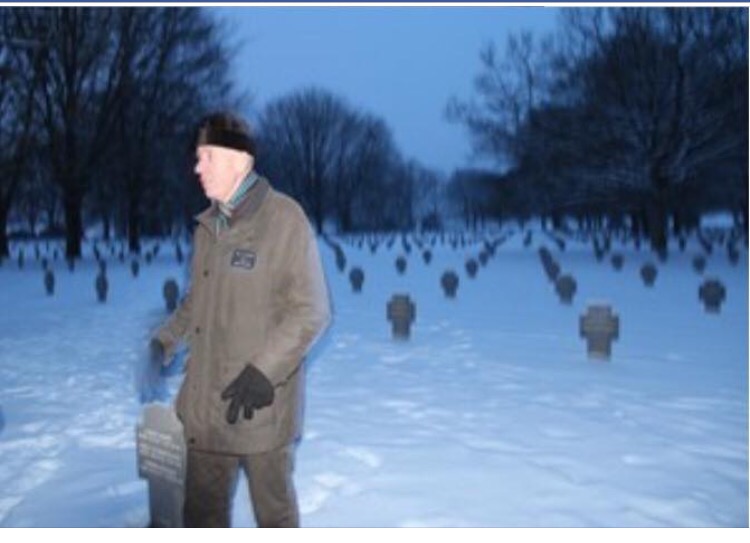
#HenriMignon was our local guide in #Bastogne. He had spent his entire life in Bastogne. In 1944 he was six years-old during the Battle of the “Bulge”, when the Allied Forces first liberated Bastogne from Germany, then became besieged in the surrounding Ardennes by a German counterattack, before finally pushing the Germans back across Belgium.
Henri recalled the German soldiers occupying his family house, but noted a difference between the regular #Wehrmacht and the #SS. The SS were “young, arrogant, and brutal.” They did not get along with the other Germans, and were an “army within an army.” When an SS officer demanded that the Mignons vacate their house, the Wehrmacht officer, who outranked the SS officer, told the family that they could stay as long as the Wehrmacht officer said so. So they stayed, for a while…

On the last day of the German occupation, and during the Allied bombings, Henri and a friend hid in the cellars. They heard a “hello”, but they were suspicious of the accent. Through the holes, they say that it was a German officer with a lugar, possibly trying to find other Germans (suspected of fleeing to surrender). A while later, they heard another “hello.” This time it was two American soldiers. The Americans entered the cellar, looked around, then told Henri and his friend to get out of the cellar. When Henri and his friend left the cellar, they realized that the house was on fire. The Americans were “very kind” and gave him and his friend chocolates. 

In Bastogne, Henri emphasizes, nobody says anything bad about Americans. If they do … he gestures by drawing his finger across his throat.

The Belgian girls were smitten by the Americans, though many had also had “affairs” with German soldiers during the occupation. All the “Belgian boys were gone fighting the war,” Henri remarked,in a matter-of-fact manner. But, he noted, after the liberation of Bastogne, those who were accused of having affairs were punished by having their heads shaved as a mark of treason.

On the other hand, when the war ended, it was a “great period” for the children. Henri became animated, and his eyes lit up, describing the crashed planes and abandoned tanks in the countryside. Decades later, Henri the grandfather would boast to his grandchildren that he “played with the real things.” Henri and two friends always went together to climb around the tanks, and play with ammunition that they found. Of course, there were many accidents. The civilians had no idea of what they were doing, when playing the ammunition. One day Henri’s friends went off without him, and were playing with ammunition they found when it went off, killing one of Henri’s friends. Today Henri sees all the video war games, and reminds his grandchildren, “#war is not a #game.”

Multiple times during the tour, Henri mentions that no American President has visited Bastogne for the anniversaries of the Battle of the Bulge. Once, there were black vehicles that went through the town. President Obama was in Europe to receive the Nobel Peace Price. The town went into a frenzy, speculating that maybe the American President was coming to Bastogne. But after the black vehicles departed and no American president was seen, the town went back to its typical business.

“I hope to see the day the President comes,” Henri says. He explains how it was personally important to thank the Americans for liberating Bastogne from German occupation, and how meaningful it would be to him, to be able to express that gratitude, in Bastogne, where so many reminders of 1944 – tanks, machine gun holes in the side of century-old homes – still litter the country side, to an American President.

I joke with Henri that I’ve heard him, and if I ever become president, I was promising then and there, that I would return to Bastogne to receive his thanks on behalf of the American people.

“It’s not political,” he adds. Then, after a pause, he carefully notes, looking away into the distance, “But if #DonaldTrump wins … I don’t know, it would be very … surprising … for us.”


[Photo of Henri from his website]

https://en.m.wikipedia.org/wiki/Battle_of_the_Bulge

Standard

The Baby in the Well

“Why do people respond to these misfortunes and not to others? … Rifkin and others have argued, plausibly, that moral progress involves expanding our concern from the family and the #tribe to #humanity as a whole. Yet it is impossible to empathize with seven billion strangers….. Our best hope for the future is not to get people to think of all humanity as family—that’s impossible. It lies, instead, in an appreciation of the fact that, even if we don’t empathize with distant strangers, their lives have the same value as the lives of those we love”, share the same skin color or practice the same religion with.
http://www.newyorker.com/magazine/2013/05/20/the-baby-in-the-well

And we would be wise, too, to afford them the same #dignity in times of misfortune, lest the disparate treatment causes the gap in/focus on differences to grow wider, and potential for conflict to grow greater.

Standard

Parochial Boys 

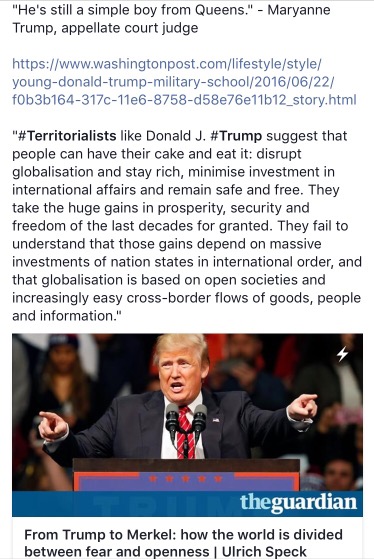
“He’s still a simple boy from Queens.” – Maryanne Trump, appellate court judge 
https://www.washingtonpost.com/lifestyle/style/young-donald-trump-military-school/2016/06/22/f0b3b164-317c-11e6-8758-d58e76e11b12_story.html


“#Territorialists like Donald J. #Trump suggest that people can have their cake and eat it: disrupt globalisation and stay rich, minimise investment in international affairs and remain safe and free. They take the huge gains in prosperity, security and freedom of the last decades for granted. They fail to understand that those gains depend on massive investments of nation states in international order, and that globalisation is based on open societies and increasingly easy cross-border flows of goods, people and information.”

Standard

Rule of Law in a Democratic Nation

Political Real talk – Legal and Financial theory edition:
1. Rule of law and adherence to norms is crucial in a capitalist economy. Take contracts, for example. You enter into contracts with strangers you have no reason to otherwise trust, because you believe the other party will nevertheless fulfill the terms because a court would uphold those terms. Trust in the *system lowers all kinds of potential transaction costs compared to corrupt and/or opaque systems (see, China). 
2. Rule of law and adherence to norms thus provides the predictability that encourages investment. Beyond day-to-day transactions and contracts, US capital markets are considered the best because of both size, transparency/regulation. Companies want to access cash, investors don’t want to get swindled. (US treasuries are considered amongst the safest debt.) Only the riskiest investors are in Russia and Nigeria!
3. Investment creates jobs. When a company accesses capital to grow, it hires! When companies hire, employment goes up, purchasing power goes up, demand goes up, the economy goes up! And stock markets also do well – which is how investors are rewarded for parting with their cash in the present, for *potential return in the future.
4. Pension funds invest in markets. Teachers, firemen, police, government employees – pension funds depending on market returns in a healthy, growing economy, to be able to deliver when people retire and collect (you didn’t think your money was simply being held in a bank account on your behalf – I hope not!) #Mainstreet is tied to #Wallstreet! (Compensation to finance professionals, tax rules, and carry percentages/moral hazard is a separate topic)
5. Rich people …. oh, we’re talking about rich people now. Well, Jeff Bezos probably doesn’t care as much as you think he does if his net worth drops $100 million. But a pensioner might care, at the time of his/her retirement, if the market that year tanks 10% then the economy enters a 5-year recession, causing the State government to force renegotiations over pensions that can’t be funded. 
6. When the markets/economy goes to shit, rich people may theoretically have more to “lose”, but the average Joe actually *feels more pain.
7. When there is uncertainty, investment slows. People with money stop investing, companies with cash stop hiring (see, e.g. all the corporate stock buy-backs post-financial crisis! Low reinvestment rates!) Workers – blue collar workers – tend to be the first to lose jobs! People with money makes less money, but “average Joe” actually feels the pain.
8. Ok … politics. When Rule of Law is threatened by Rule by Man, guess what? When democratic institutions are weakened and the judiciary slandered, when experts are dismissed and mob “justice” encouraged, guess what! The whims of a populist demagogue …. is just … all so unpredictable. The rich, educated “elites” (e.g. 100 tech leaders) probably think, eff this. America isn’t so clearly first; free capital movement – to India, and beyond (or, corporate America, sit on cash piles and not reinvest, not hire).
9. When the American economy contracts because of political uncertainty (see, eg, Brexit), those who voted for the demagogue feel the pain first. The “elite” will most definitely be ok (for a while).
10. Be afraid. Be very afraid.

Standard

Terrorism Epidemic


Rudy Giulani screams “They are coming to kill us!”

Marcus Lutrell intones “The war is here.”

Lt General Michael Flynn caps off, “This is the last stand.”

I’ll have fruit loops for breakfast.

#RNC2016

The Threat Is Already Inside

http://www.theguardian.com/us-news/2016/mar/09/america-cia-nsa-chief-general-michael-hayden-china-catastrophic-for-world

http://www.theguardian.com/us-news/2016/mar/10/barack-obama-interview-middle-east-drone-strikes-atlantic

Standard

The Good King


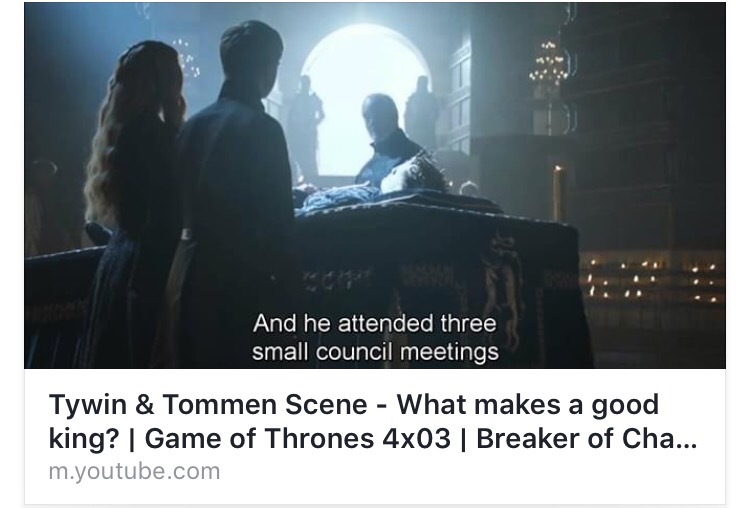
#TywinLannister: What kind of king do you think you’ll be?

Tommen Baratheon: A good king?

Tywin: I think you will. You have the right #temperament. But what makes a good king? What is a good king’s single most important quality?

Tommen: #Holiness?

Tywin: Baelor the Blessed was holy. And pious. He built this sept. He also named a six-year-old boy High Septon because he thought the boy could work miracles. He ended up fasting himself into an early grave because “food was of this world, and this world was sinful.”

Tommen: #Justice?

Tywin: A good king must be just. Orys the First was just. Everyone applauded his reforms, nobles and commoners alike. He was murdered in his sleep after less than a year, by his own brother. Was that truly just of him, to abandon his subjects to an evil he was too gullible to recognize?

Tommen: No. … What about #strength?

Tywin: Yes. Strength. King Robert was strong. He won the rebellion and crushed the Targaryen Dynasty and he attended three small council meetings in seventeen years. He spent his time whoring and hunting and drinking until the last two killed him. So, we have a man who starves himself to death; a man who lets his own brother murder him; and a man who thinks that winning and ruling are the same thing. What do they all lack?

Tommen: #Wisdom!

Tywin: Yes!

Tommen: Wisdom is what makes a good king.

Tywin: But what is wisdom? Hmm? A house with great wealth and fertile lands asks you for your protection against another house with a strong navy that could one day oppose you. How do you know which choice is wise and which isn’t? You’ve any experience of treasuries and granaries or shipyards and soldiers?

Tommen: No.

Tywin: No. Of course not. A wise king knows what he knows and what he doesn’t. You’re young. A wise young king listens to his counselors and heeds their advice until he comes of age. And the wisest kings continue to listen to them long afterwards.

#GameOfThrones #DonaldTrump
Donald Trump: I consult myself on foreign policy, ‘because I have a very good brain’

http://m.washingtontimes.com/news/2016/mar/17/donald-trump-i-consult-myself-on-foreign-policy-be/
“What I think is scary is a president who doesn’t know their stuff and doesn’t seem to have an interest in learning what they don’t know.” – Barack Obama


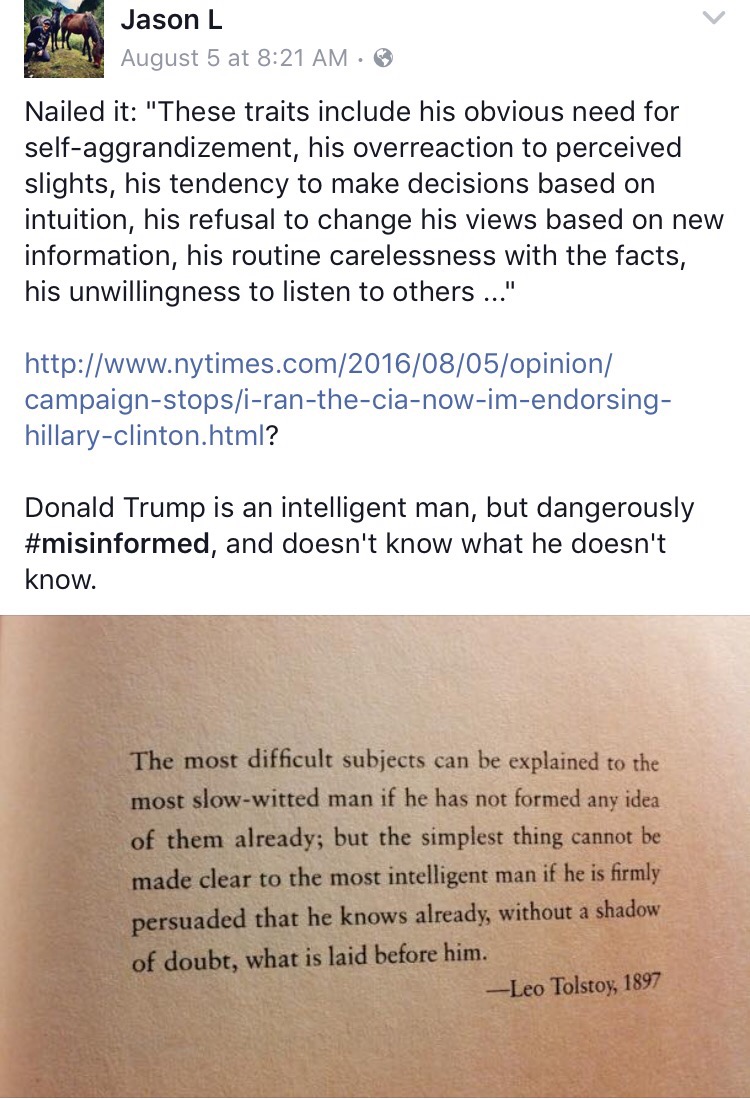
Trump aspires to be #Tywin, projecting strength and a pragmatic “common sense” worldview, but he’s actually much closer to #Joffrey, a cruel, narcissistic, ignorant boy, who has never mentally “come of age”:

https://m.youtube.com/watch?v=doY0IjisBlk

Standard

Asset Trump


The history of covert political influence abroad goes way back … before James Bond was James Bond, there was Her Majesty’s Service’s Sidney Reilly, fomenting Russian domestic unrest in attempts to topple Lenin’s still fragile, post-October Revolution (1917), Bolshevik party.


Long before Vladimir Putin was Russian President, he was a young KGB intelligence agent working in Germany. Shouldn’t be a surprise he is versed in the arts of disinformation but also, more interestingly, honed an appreciation for how popular disillusionment can be mobilized to topple political establishments:

“The experience …. left him with a huge anxiety about the frailty of political elites, and how easily they can be overthrown by the people.

“Putin had arrived in Dresden in the mid-1980s for his first foreign posting as a KGB agent. The German Democratic Republic or GDR – a communist state created out of the Soviet-occupied zone of post-Nazi Germany – was a highly significant outpost of Moscow’s power, up close to Western Europe, full of Soviet military and spies.

“Putin had wanted to join the KGB since he was a teenager, inspired by popular Soviet stories of secret service bravado in which, he recalled later, “One man’s effort could achieve what whole armies could not. One spy could decide the fate of thousands of people.”

“Initially, though, much of his work in Dresden was humdrum. Among documents in the Stasi archives in Dresden is a letter from Putin asking for help from the Stasi boss with the installation of an informer’s phone.

“But if the spy work wasn’t that exciting, Putin and his young family could at least enjoy the East German good life. Putin’s then wife, Ludmila, later recalled that life in the GDR was very different from life in the USSR. “The streets were clean. They would wash their windows once a week,” she said in an interview published in 2000, as part of First Person, a book of interviews with Russia’s new and then little-known acting president…

“He enjoyed very much this little paradise for him,” says Boris Reitschuster. East Germany, he says, “is his model of politics especially. He rebuilt some kind of East Germany in Russia now.”

“But in autumn 1989 this paradise became a kind of KGB hell. On the streets of Dresden, Putin observed people power emerging in extraordinary ways.

http://www.bbc.com/news/magazine-32066222

Standard