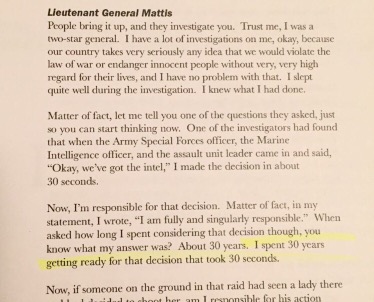
30 years preparation for 3 seconds

I am not convinced that Donald Trump has spent the last 30 years with any reflection or introspection, whatsoever, to make a decision in 30 seconds with US nuclear codes, in a way that does not endanger our very country.
Nor would he listen to someone who has. The Donald listens to himself, he has a very good brain.

*****

“Hayden, who also served as director of the NSA and CIA under both Democratic and Republican presidents… explained that if a President Trump wanted to use nuclear weapons, he could use nuclear weapons. ‘It’s scenario-dependent,’ Hayden said. ‘But the system is designed for speed and decisiveness. It’s not designed to debate the decision.’

https://www.yahoo.com/tv/joe-scarborough-says-donald-trump-asked-three-171548781.html

*****


“I spent 30 years getting ready for that decision that took 30 seconds.” – General James Mattis, US Marines

“Your spiritual path is much … of your own choosing. Make sure you don’t dismiss this as something of idle interest or not that important… You can sometimes put things on the spiritual level behind you, and the problem is then we endanger our very country.”

https://www.usna.edu/Ethics/publications/lectures.php

“Our country takes very seriously any idea that we would violate the law of war or endanger innocent people without very, very high regard for their lives.”

32:40 https://m.youtube.com/watch?v=xIYkAAdAe8I&sns=fb

Standard

First Kill All the Lawyers?

“Leah D. Frank is inaccurate when she states that when Shakespeare had one of his characters state ‘Let’s kill all the lawyers,’ it was the corrupt, unethical lawyers he was referring to. 
“Shakespeare’s exact line ‘The first thing we do, let’s kill all the lawyers,’ was stated by Dick the Butcher in ”Henry VI,” Part II, act IV, Scene II, Line 73. Dick the Butcher was a follower of the rebel Jack Cade, who thought that if he disturbed law and order, he could become king. Shakespeare meant it as a compliment to attorneys and judges who instill justice in society.”

http://www.nytimes.com/1990/06/17/nyregion/l-kill-the-lawyers-a-line-misinterpreted-599990.html

This still gets to me, in a way that maybe Paris or Brussels resonates to more Americans.

Maybe it’s because even as an American born in Jersey, I spent 3rd grade through high school attending American schools abroad, and growing up in a multicultural environment, the common ways people self-identify here in the US is less relevant to me – whether that *tribal self-identification is primarily ethnic (Italian American?), regional (Bostonian?), religious (Baptist?), socio-economic, etc.

Instead, my self-identification has always seemed a bit more fluid, and settled on things that are trans-national, trans-racial, trans-ethnic, etc., and goes more directly to values which all the aforementioned identities may in some cases simply be assumed proxies for.

So as a lawyer who has spent brief but significant chunks of my life on Rule of Law issues, whether in Iraq or Afghanistan or more tangentially even in the United States, and who believes in the role of Law in maintaining civil society, I see the attack on these lawyers, of a different nationality, of a different religion, from a different culture, as an attack on my “tribe.”

—–

https://www.washingtonpost.com/news/worldviews/wp/2016/08/09/an-entire-generation-of-a-citys-lawyers-was-killed-in-pakistan/

Baluchistan is a place that desperately needs lawyers.

Pakistan’s largest province by area, it is the home of a decades-old separatist insurgency, fueled by real grievances over neglect and lack of political representation. It is also increasingly the target of Sunni extremists, who bomb and kill its Shiite minorities. What leaders the province has are widely considered corrupt. Dozens of local journalists have been kidnapped in the past few years. It is nearly impossible for foreign reporters to enter Baluchistan. Lawyers are almost all that give the province a semblance of justice.

About 60 of them were killed in one attack on Monday in Baluchistan’s capital, Quetta. They were packed into an emergency room where the body of a slain colleague lay, riddled with gunshot wounds. A widely circulated video showed lawyers milling about the hospital before an enormous explosion. A Pakistani Taliban offshoot claimed the attack, as did the Islamic State, though analysts say the latter’s claim is dubious.

A week earlier, another lawyer was fatally shot. In June, the principal of the province’s law college was, too.

A generation of lawyers has been wiped out in Quetta, and it will leave Baluchistan, in more ways than one, lawless.

On Tuesday, the Pakistani bar association called for an indefinite boycott of the courts. But so few lawyers are left in Baluchistan that it will be years, probably, until its legal community recovers.

Standard

A new beginning

The first half of the 1900s was defined by the two World Wars. Most of the latter half was defined through the “Cold” War. From 1989-present, a relatively brief 20+ years, the narrative has been Globalisation (though hardly a global phenomena, or an uneven one at best).
Well, maybe this is the beginning of *that end. 
I’d bet more on the possibility of Brexit and the unraveling of the EU, more than a Trump presidency, but the tides of nationalism/tribalism are everywhere. (And the reality is, the former can’t be simply reversed in another four years; whereas US presidential elections are an every-four year event, the European Project is a generational one)
Most America will go on – as the world shifts and changes across two oceans – too busy re-arranging house, without due attention to the fires outside.
But what the next period will be defined by … those ripples will surely reach our shores.
http://www.telegraph.co.uk/business/2016/06/07/france-shuns-europe-as-brexit-revolt-spreads/

Standard

I’m Not Into Politics = Not My Problem

You ask somebody in NC what they think about the recent bill re:LGBT and transgender rights, and they might say “idk i’m not into politics.”

But it’s not about being into politics.

People ignore that politics is merely a means (a process) to an end – whether that end is social equality, financial reform, health care – things that affect our day to day lives, depending on our individual situation.

When people, or even businesses, say “I’m not into politics” or “I’m not political” – what they are really saying is “I don’t care because this particular issue is someone else’s problem”/”it doesn’t affect my bottom line” (bc you don’t hear someone say “idk, i’m not really into what happens to *my life”)

Hypothetical: Your city or state or country announced its raising *everybody’s taxes by 30% (to build roads or hire public school teachers or give all cops body cams). How many of us will shrug and say “idk i’m not into politics” and pay +30% tax feeling nothing at all.

Or, you live in Russia or China or some country where you just accept everything, good or bad, personal or someone else’s problem, because Putin/Xi don’t give a shit what you think and how you feel, or its *dangerous to be *political.

Nobody is going to care about everything, but everybody cares about something.


And rarer still, are those who have greater empathy for those unlike themselves are being harmed:

https://www.facebook.com/notes/bruce-springsteen/a-statement-from-bruce-springsteen-on-north-carolina/10153539447566824

Standard

Of Caves and Myths


“The great enemy of the truth is very often not the lie, deliberate, contrived and dishonest, but the myth, persistent, persuasive and unrealistic.” – John F. Kennedy


Deconstructing myths is oftentimes more tiresome than explaining the truth (in all its complexity, all the gray), wherein the most common form of ignorance isn’t no information (not knowing anything), but misinformation (believing the wrong thing).  
Just try explaining the world being round to a 5-year old versus the rapper BoB.


Yet sometimes myths are more than just amusing; they can become dangerous. 


“It ain’t what you don’t know that gets you into trouble. It’s what you know for sure that just ain’t so.” – The Big Short (film)
I can’t even.


EPILOGUE


The most difficult subjects can be explained to the most slow-witted man if he has not formed any idea of them already; but the simplest thing cannot be made clear to the most intelligent man if he is firmly persuaded that he knows already, without a shadow of doubt, what is laid before him. – Leo Tolstoy

https://scatter.wordpress.com/2016/01/16/the-big-short-and-the-most-ironic-quote-misattribution-ever/


Standard

Civics 101 – 

Why I think Apple could win on #legal grounds, despite finding Apple PR disingenuous as to what the FBI is actually requesting: 

The All Writs Act gives federal courts authority to issue “all writs necessary or appropriate in aid of their respective jurisdictions and agreeable to the usages and principles of law,” however “the power of federal courts to impose duties upon third parties is not without limits; unreasonable burdens may not be imposed.”


Thus, while the 2d Circuit ultimately found a district court order, directing the NY Telephone Co. to assist the FBI in installing and operating pen registers on two telephone lines, lawful, it also expressed the concern an expansive reading of the All Writs Act could establish an undesirable precedent for the authority of federal courts to “impress unwilling aid on private third parties.” And while the 2d Circuit upheld the order against NY Telephone Co, it noted that NY Telephone Co is a public utility “with a duty to serve the public.”


Apple lawyers would likely argue, amongst other things, that Apple is a “private third party” (with fiduciary duties to its shareholders, not the public), and that requiring it to create unique software, that does not currently exist, to allow the government to brute force hack an iPhone more quickly, creates an “unreasonable burden.”


The case would be distinguishable from law enforcement obtaining a valid warrant to search a house, going to the landlord, and having the landlord open the door to the house via a duplicate key. Rather, it goes to Tim Cook’s point that the USG is asking Apple to create something that does not exist – and, a persuasive legal argument that an “unreasonable” burden is being imposed on a private third party. 

Ultimately, private parties should not be conscripted into being an extension of the government. A private company’s legal fiduciary duties are to it’s shareholders (which would arguably include actions to find tax shelters abroad, and harboring billions of dollars of profit abroad to avoid incurring tax liability, to the extent permitted by law). Opening a door to a house with a duplicate key that already exists creates no or little burden, but requiring a private company to create a key that does not exist, strays closer to effective conscription of a private company into the service of the government. Crossing that line could be the “overreach” the All Writs Act did not anticipate.


US v. NY Telephone Company (2d Circuit, 1977)
https://casetext.com/case/united-states-v-new-york-telephone-co

—–

Why doesn’t the media report on the *legal issue(s)? – “In fact, our ruling[s] [are] that whoever does get to decide this or that is allowed to do it, and that it’s not unconstitutional, that it’s consistent with the law,” Roberts said. “But we often have no policy views on the matter at all, and that’s an important distinction.”

https://www.washingtonpost.com/politics/courts_law/the-political-wars-damage-public-perception-of-supreme-court-chief-justice-roberts-says/2016/02/04/80e718b6-cb0c-11e5-a7b2-5a2f824b02c9_story.html

What sometimes irks me regarding the Apple-FBI court battle is what it doesn’t talk about. And that is … the law.
Right now there is a rather narrow issue being considered in a court of law.
But very little is being reported on the narrow legal issue. Rather, much public attention is focused on the broader security v privacy *policy debate.
The question before the court right now is (a) whether the order compelling Apple to comply with the DOJ’s request is lawful, not (b) whether “backdoors”, even pursuant to a valid court orders, are a bad idea.

(a) is what courts decide, (b) is what legislatures determine.

Confusing the two risks arriving at the conclusion the corporations are above the law. That if Apple is “right” on public policy grounds, then it is “right” in opposing a court order.

*That* is a dangerous precedent to establish in the court of public opinion.

Apple Isn’t Above the Law, Even If Tim Cook Is Right About Protecting Privacy

A legal appeal is entirely within due process – focusing on legal issues. So, I don’t agree with the author’s implication that anybody should automatically accept the legality of a court order. 

My beef is with what seems to be a popular notion amongst privacy advocates that *policy positions justify defiance of an otherwise valid court order, as the order stands.

The pro-Apple protesters need to spend their time lobbying their Congressmen, or in a classroom brushing up on their civics 101, not picketing outside FBI headquarters.

http://www.theguardian.com/technology/2016/feb/23/fbi-apple-pr-war-encryption-mobile-security

—–

Mr. Comey struck a conciliatory tone, saying he believes in encryption and privacy, and at no point criticizing Apple or Silicon Valley. “There are no demons in this dispute, or the larger dispute,”’ he said.


He said the issue of privacy, security and criminal investigations are weighty matters that should be decided by the country, not just the FBI and Apple.


“The San Bernardino litigation is not about us trying to send a message or set a precedent,’’ Mr. Comey said. “The FBI focuses on a case, and then a case, and then a case.’’


The FBI director was repeatedly pressed on what policy prescriptions he would offer in the debate over encrypted data, but said he wanted the FBI to offer information, not opinions. 


If law enforcement conducting an investigation cannot look at data on a phone even with a court order, he said, “the world will not end—but it will be a different world.”


http://www.wsj.com/articles/fbi-chief-says-finding-right-balance-on-encryption-is-hardest-question-1456418466

Standard

Excellence in the Basics

In the Marine Corps’ Basic Officer’s Course, there is instruction in field first aid. academically, 80% is passing, but the instructors will tell you – that’s not good enough, because in real life, 80% might still = dead. A motto at Basic School is, appropriately, “Excellence in the Basics”
anyway, US GED education should really include two important courses:
(1) Personal Finance (this would undoubtedly have benefited Talia Jones, disgruntled former-Yelp millennial, and many others)
(2) Civics/US Government – this would have benefitted even Donald Trump, who campaigns on promises of unconstitutional Executive action
This is about addressing a cause of so much of our socio-economic-political dysfunction, not the symptoms.
The fact that significant swathes of our nation are, frankly, ignorant as fuck, when it comes to the Basics.

Standard

Skates and Politics

NHL Hall of Fame center Wayne Gretzky famously spoke of skating, not to where the puck is, but where the puck is going.
Many Republicans are worried that a Trump nomination will wreck American conservatism in 2016. We – Americans of all political inclinations – should be worried that a Trump presidency will wreck American government, beyond a 2016-2020 term, by weakening faith in our institutions.
For example, you could be a zealous privacy/encryption advocate. And yet, as of right now, there is a FBI Director on record as saying that the FBI, while pursuing its mission, should not ultimately be the one determining the appropriate balance between privacy-security (though neither does he believe a corporation that sells stuff should) – and that a legitimate public debate is, in the broader context, appropriate. Same guy who as a deputy under the Ashcroft DOJ threatened to resign, as did then-FBI Director Mueller, during the Bush Administration’s earlier go-arounds re-authorizing the NSA Prism program brought to light by Ed Snowden. Bush gave ground.
Say what you will, your USG is not a monolithic entity of robotic bureaucrats. There may be folks who disagree with you on issues, whether due to personal ideology, or job role, but they are not inherently unreasonable, even when under immense political pressure from elected leaders.
Now, imagine if a Trump, who proposes things that constitutional scholars of all political inclinations pan as unconstitutional, were president, and simply said, ok “You’re fired” and put into the Executive Branch a cabal of Yes Men.
Essentially, think of Nixon, but probably worse. Much worse.
Watergate and Nixon era intelligence scandals broke a lot of trust the American people had in its government, that today’s law enforcement and intelligence agencies still pay a price in trying to overcome – e.g. the broad distrust between Academia and law enforcement that has roots in historical enmities, and has never recovered in a way that the relationship between the public and the Vietnam era US military has.
The way the President of the United States intends to wield the instruments of Executive Power can diminish those instruments standing with the American people for years to come, and long after those Presidents are gone – and to the detriment of American society. 
We’ve not, it seems, gone over a tipping point, in which the breach becomes too wide to mend, but, given the tenor of a Trump candidacy, its disdain for rule of law, and the demeanor of Trump himself, where this puck is heading toward is scary indeed.
—-
“The next day, as terrorist bombs killed more than 200 commuters on rail lines in Madrid, the White House approved the executive order without any signature from the Justice Department certifying its legality. Comey responded by drafting his letter of resignation, effective the next day, March 12.
“I couldn’t stay if the administration was going to engage in conduct that the Department of Justice had said had no legal basis,” he said. “I just simply couldn’t stay.” Comey testified he was going to be joined in a mass resignation by some of the nation’s top law enforcement officers: Ashcroft, Mueller, Ayres and Comey’s own chief of staff.
Ayres persuaded Comey to delay his resignation, Comey testified. “Mr. Ashcroft’s chief of staff asked me something that meant a great deal to him, and that is that I not resign until Mr. Ashcroft was well enough to resign with me,” he said.
The threat became moot after an Oval Office meeting March 12 with Bush, Comey said. After meeting separately with Comey and Mueller, Bush gave his support to making changes in the program, Comey testified. 
http://www.washingtonpost.com/wp-dyn/content/article/2007/05/15/AR2007051500864.html
“Reflecting the context of this heart-breaking case, I hope folks will take a deep breath and stop saying the world is ending, but instead use that breath to talk to each other. Although this case is about the innocents attacked in San Bernardino, it does highlight that we have awesome new technology that creates a serious tension between two values we all treasure: privacy and safety. That tension should not be resolved by corporations that sell stuff for a living. It also should not be resolved by the FBI, which investigates for a living. It should be resolved by the American people deciding how we want to govern ourselves in a world we have never seen before. We shouldn’t drift to a place—or be pushed to a place by the loudest voices—because finding the right place, the right balance, will matter to every American for a very long time.”
https://www.lawfareblog.com/we-could-not-look-survivors-eye-if-we-did-not-follow-lead


July 6, 2016

“It was just weeks after he joined Bridgewater—whose corporate culture of high-achieving intellectuals resembles a moneyed management cult that shares more in common with the 1970s personal-improvement fad est than it does with a typical Wall Street firm—that Comey was cornered by a similarly new 25-year-old employee. The junior associate interrogated the former Justice Department official on a seemingly illogical stance that Comey had taken in an earlier meeting. “My initial reaction was ‘What? You, kid, are asking me that question?’ … I was deputy attorney general of the United States; I was general counsel of a huge, huge company. No 25-year-old is going to ask me about my logic,” he recalled. “Then I realized ‘I’m at Bridgewater.’”
Comey said that, even though he was excited to embrace the new way of thinking, it took him at least three months to settle in with Bridgewater’s culture. “I finally relaxed and untied the knot in my stomach that would instantly appear when someone questioned me,” he recalled. 
“Bridgewater’s a hard place. … It’s a place filled with really smart people who are always going to tell you the truth, and that’s hard.”


http://www.politico.com/magazine/story/2016/07/fbi-director-james-comey-house-of-representatives-investigation-hillary-clinton-emails-chaffetz-hedge-fund-214018

Epilogue

With his son in the crosshairs of federal investigators, you can bet on it.


Almost from his first moments in office, President Trump and his allies have launched a fierce assault on the Department of Justice. Those attacks have been designed to insulate his presidency from a widening scandal, but with new revelations about his son Donald Trump Jr.’s meeting with a Russian attorney bringing the threat of criminal charges into the president’s own family, what we have seen to date from the president may be only the beginning of an unprecedented campaign to weaken one of his own Cabinet agencies.


President Trump and his allies have launched a two-pronged assault on the agency: first by trying to coopt it from within, and when that seemed to fail, subverting it from the outside. 


It’s doubtful Trump cares much about the ramifications for DOJ itself or the effects a weakened department would have on the rule of law. But a collapse in the department’s institutional credibility would come at a severe cost to the country.


The Justice Department holds a unique place in the president’s Cabinet. Thanks to post-Watergate reforms and the development of strong institutional norms that place a premium on independence, DOJ is supposed to makes its own calls about who to investigate or prosecute, free from presidential interference.


Trump, however, has treated the department like his own personal fiefdom, answerable to him in the same way he expected subordinates in his business empire to operate. He demanded loyalty from the FBI director, Jim Comey, and asked him to back off an investigation into former national security adviser Mike Flynn. He erupted when Attorney General Jeff Sessions followed longstanding rules and recused himself from the probe. When the investigation continued, he asked the director of national intelligence and the head of the National Security Agency to intervene with the FBI—virtually the same request Richard Nixon made in his famous “smoking gun” tape. Each of these actions was a major breach of protocol, and when none of them worked, Trump fired Comey.


Since the Comey firing and the subsequent appointment of special counsel Robert Mueller, Trump has turned to subversion to weaken the Justice Department. 


He has publicly questioned whether Mueller is fair – repeatedly calling his investigation a witch hunt and casting doubt on his impartiality because he has hired prosecutors who have previously contributed to Democrats. 


Attacking investigations as politically motivated is a time-worn tactic by political figures under scrutiny. But such attacks are different when they are made personally by the head of the executive branch, who holds the unique ability to hire and fire senior DOJ officials. Trump clearly understands this. 


After sacking Comey, he has now publicly flirted with the possibility of doing the same to Mueller. As his aides told the New York Times, he hoped that merely floating the idea of firing the special counsel would make him more malleable and increase the chances that he clears the president.


Trump’s attacks are also more likely to cause long-term lasting damage to the Justice Department’s credibility because of the position he commands in today’s polarized political and media environment. Between Fox News, Breitbart, One America News Network and a host of similar right-wing outlets, every utterance from Trump is echoed by a chorus of voices who hold sway over an ever-increasing portion of the population. A recent Survey Monkey poll found that 33 percent of Republicans get their news only from Fox, and 89 percent of Republicans trust the president more than they do CNN.


Over the years, the Republican Party has perfected a formula of using the right-wing media to wage similar campaigns against the credibility of climate-change scientists, academia, government experts and other elite institutions whose independent voices challenge conservative orthodoxy. Those campaigns have worked. 


For example, the Pew Research Center found last month that 58 percent of Republicans and Republican-leaning independents now say that universities have a negative effect on the country. The GOP built a Death Star to destroy the news media, then turned it on other targets. Trump is now pointing it squarely at the Justice Department.


If Trump succeeds in impairing either the independence or the credibility of the Justice Department, the consequences could be irreversible. DOJ depends on the confidence of the public to execute its mission. It needs witnesses to cooperate with its investigations, whistleblowers to have faith it will listen to their concerns and juries to believe its prosecutors are telling the truth. 


If Trump is able to turn roughly a third of the country’s population against it – as conservatives have with other once-respected institutions – its ability to execute this mission will suffer dramatically.


Thanks to last year’s presidential campaign, the Justice Department began 2017 in its most vulnerable position in years. Both Comey and former Attorney General Loretta Lynch bear responsibility for mistakes in their handling of the Clinton investigation, Lynch through her tarmac meeting with Bill Clinton and subsequent ham-handed attempts at recusal and Comey through his breach of longstanding DOJ rules to publicly discuss the case. They cracked the door Trump is now barging through, but it is up to the rest of us to close it firmly.


As the Russia investigation draws closer to Trump, his family, and his associates, his assault on the Justice Department is only likely to increase. If its mission is to be saved, it will be because voices from both parties who respect the rule of law stand up for it.


http://politi.co/2tF4uSX

Standard

Letters to Millenials

My first full-time job out of college included the duties of hauling loads of trash – by a two-wheeled wagon – to a burn pit. Then I’d get to go home early some days after I sprayed pesticide, because the boss said better safe than sorry, go home early to take a shower, in case any of the pesticides got on my skin. That’s what you get for being a #forestry major, rather than an english major! I lived at home and took the bus to work.
Workin’ in a greenhouse, grafting shit, fertilizing shit, hauling shit to the burn pit…. 
Actually, that experienced served well a decade later as a Captain in the Marines assigned to Multi-National Force Iraq, where General Paxton, then Petraeus’ Chief-of-Staff, reminded the staff officers, that regardless of your rank, “some days you’re the peacock; some days you’re the feather duster.”

View at Medium.com

Standard

Stream of consciousness – Wall St ed.

While the standard schtick against Wall Street goes on, whats happening in San Francisco is probably a better measure of increasing challenges in wealth inequity:
“The new tech-economy wealth is increasingly concentrating in the hands of relatively few innovators and financiers, leaving the middle class and its consumer demand lagging behind. What is the appropriate role of government in redressing this?

“An America-appropriate policy response to the inequality challenge needs to be focused on equalizing opportunities, not outcomes. At the very least, removing barriers to social mobility will require tax, regulatory and educational reforms to give people the qualifications and liberty to improve their lives in the new economy.”
http://www.wsj.com/articles/the-young-and-the-economically-clueless-1455924699

—–

“In only the latest cultural altercation between San Francisco’s tech workers and the city’s impoverished population, one tech worker has declared the homeless are ‘riff raff’ whose ‘pain, struggle and despair’ shouldn’t have to be endured by ‘wealthy’ people commuting to work.

It’s a familiar story. A male entrepreneur (some might even call him a “tech bro”) takes a moment to think about homelessness [and] publishes them on the internet. Justin Keller, an entrepreneur, developer and the founder of startup Commando.io… published an open letter to San Francisco mayor Ed Lee and police chief Greg Suhr:

“We live in a free market society. The wealthy working people have earned their right to live in the city. They went out, got an education, work hard, and earned it.”

http://www.theguardian.com/technology/2016/feb/17/san-francisco-tech-open-letter-i-dont-want-to-see-homeless-riff-raff
(There’s a narrative in the U.S. that “everybody starts out equally,” Emmons said. “The results that we keep coming across suggest that’s kind of hard to imagine.” It’s not as difficult to see how large wealth gaps can form and persist….)

http://www.bloomberg.com/features/2016-millionaire-odds/)

—–

Seems to be a pervasive knee-jerk bashing of individual financier’s (Warren Buffet, et al) lower tax rates (from capital gains v income), but largely a public relations pass to Tech companies’ practice of off-shore tax havens (proves, reasonably, that in corporate America, keeping happy consumers trumps being good citizens):

“[G]lobal laws create an enormous financial incentive for Apple to keep its profits overseas using sophisticated subsidiaries and offshore chicanery that ultimately vastly lower its effective tax rate. 

However, it is worth remembering that in 2012, a British parliamentary committee chided executives from large tech firms for employing such tactics. Margaret Hodge, the public accounts committee chair, slammed Google’s northern European operations chief, saying, “We’re not accusing you of being illegal, we are accusing you of being immoral.”

http://arstechnica.com/tech-policy/2015/12/ceo-tim-cook-denies-tax-dodging-apple-pays-every-tax-dollar-we-owe/

—–

Whatever your views, at least be consistent. 

Not just pro-/anti- this, but blind-eye-to that, when it suits your personal convenience/preferences.

—–

I have tremendous respect for Tim Cook, but when it comes to being strictly legalistic when it suits Apple (corporate tax havens – Apple is just following what the law permits), but not so much when it doesn’t (court orders to assist law enforcement) – his bipolarism is weirdly reminiscent of someone you might never think to lump Cook in the same breathe with – Justice Antonin Scalia, and his selective textualism.

Richard Posner (no intellectual lightweight): 

Does an ordinance that says that “no person may bring a vehicle into the park” apply to an ambulance that enters the park to save a person’s life? For Scalia and Garner, the answer is yes. After all, an ambulance is a vehicle—any dictionary will tell you that. If the authors of the ordinance wanted to make an exception for ambulances, they should have said so. And perverse results are a small price to pay for the objectivity that textual originalism offers (new dictionaries for new texts, old dictionaries for old ones). But Scalia and Garner later retreat in the ambulance case, and their retreat is consistent with a pattern of equivocation exhibited throughout…

https://newrepublic.com/article/106441/scalia-garner-reading-the-law-textual-originalism

Standard